Saturday, September 15, 2012
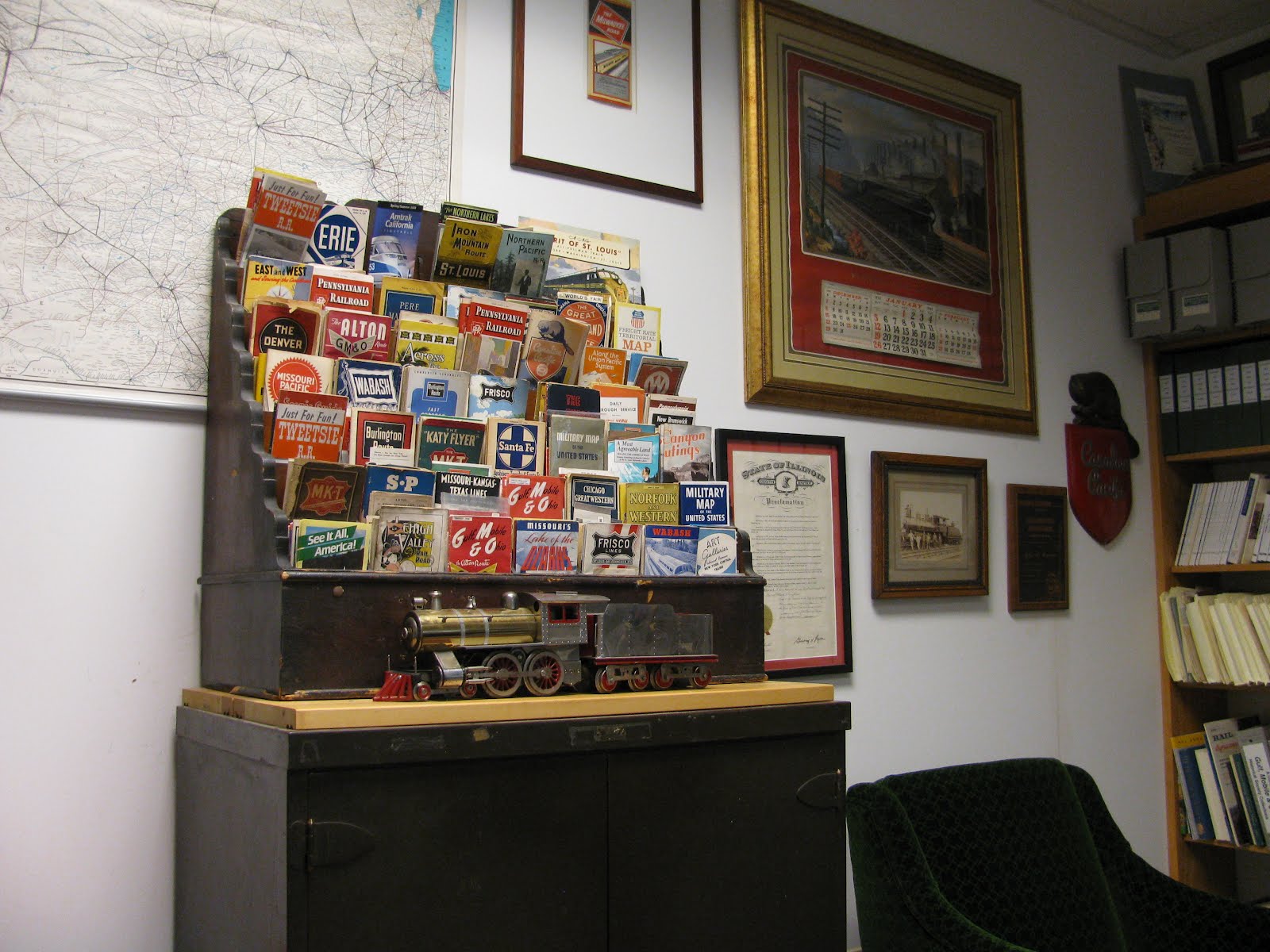
What ever happened to the library of the Bureau of Railway Economics?
The AAR still exists today but it has evolved. There's no ICC to deal with anymore since the passage of the Staggers Act. There aren't as many hearings before congress either. So the library of the BRE was not needed in Washington, DC any more. However, it contained so many historic holdings, it just couldn't be thrown away.
Fortunately there were two world class libraries that agreed to take part of the collection. The Northwestern University Library and the John W. Barriger III National Railroad Library. Each institution accepted the items from the BRE Library into their holdings and added them to their library catalogs. So now, even today, researchers can still access the contents of the library of the Bureau of Railway Economics.
Links:
Northwestern University Transportation Library
John W. Barriger III National Railroad Library
Tuesday, June 5, 2012
Thursday, December 29, 2011
The Big Chair...
Sometimes you get an opportunity that you just can't say no to. Hi, this is Nick writing again. First, please accept my apologies for the dearth of posts this year. Once you read further you may understand why things slowed down.
In June of 2011, Gregg Ames, the curator of the John W. Barriger III National Railroad Library at the University of Missouri, St. Louis, retired. The library began a search for the next curator (the 6th for you Dr. Who types.) In August an announcement appeared on the Railway and Locomotive Historical Society's chat group and this announcement was forwarded to me.
Honestly I was torn about applying. The job, if I got it, would involve a considerable move away from my family and friends. However, after passing on an announcement for an archivist at Norfolk Southern, and being told by several folks that "this is the perfect job for you," I decided to give it a go.
Applications were due by the end of September and in early October I received an email from the search committee asking for a phone interview. After the phone interview some time passed and then I got another email asking if I could come out to St. Louis for an in person interview. Now things were getting serious.
The in-person interview was actually a series of interviews with multiple communities of librarians at UMSL and was followed up by another phone interview with members of the Barriger Library's Board. This was my first experience with an academic interview process and I have to say, even if I hadn't gotten the job, the experience alone would have been worth the effort of applying.
A couple of weeks later, I got a call and was offered the job.
I said yes almost immediately.
I've told people it's like being offered the Captain's Chair on the Enterprise. Who'd dare say no?
So, starting in February 2012 I'll be in the thick of one of the best railroad research libraries in the world. I expect this blog will be moving with me, probably to a Barriger page.
Expect more posts, more research oriented work and perhaps notifications of publications and articles coming out. I've got a backlog of them still gestating in my office. I think I'll be pushing them out into the wide wide world soon.
Sunday, June 12, 2011
Why you should be thinking about state and municipal archives
Many researchers of railroad history, particularly if they are new to the field of historical research may neglect certain resources that are available to them that could greatly enhance their work. Some of those resources are contained in the various state and municipal archives throughout the nation.
For the "pioneering railroads" public financing was critical to their construction. As part of the "Era of Good Feeling" under President Monroe, the United States Government began pushing resources and expertise, in most cases engineering expertise from the young United States Army Corps of Engineers, to various national and regional transportation improvement projects.
At the state and municipal level, this translated to more tangible financial investment in these transportation projects. For the purposes of this blog, we'll use the example of the Baltimore & Ohio Railroad. The B&O Railroad, while a public corporation, received a substantial amount of money from the State of Maryland and the City of Baltimore when it was created. Later more funds were provided by the State of Virginia when it was decided to use that State's shore of the Potomac River to go west.
The funds committed to purchase B&O bonds were not insubstantial and in some cases the stock also purchased gave certain governments the ability to put directors on the company's board. This in turn led to the creation of a paper trail for the city and state governments about the railroad's finances, decisions made by the board and the views of those who represented the public monies invested in these companies.
In Maryland, these documents can be accessed via the Maryland State Archives and the Baltimore City Archives. In Virginia, one can find these items at the Library of Virginia in Richmond.
Pennsylvania invested heavily in its "Main Line" of State Works that was a canal-railroad hybrid from Pittsburgh to Philadelphia. The project was funded entirely out of state funds and was eventually sold outright to the newly chartered Pennsylvania Railroad. The state's papers are held at the Pennsylvania State Archives in Harrisburg.
Thursday, June 9, 2011
Railroad History and Digital History
Professor William G. Thomas is running a really neat operation at the University of Nebraska-Lincoln titled "Railroads and the Making of Modern America." The project presents the impact of railroads on American society with a focus on western settlement, social history and labor history. It's a nice place to see what younger scholars and students are writing about railroads and may be helpful in focusing your own research inquiries or developing your ideas for a research project.
Friday, October 29, 2010
Railroad Museum of Pennyslvania Archives and Library
A new interface for the collection of the Railroad Museum of Pennsylvania in Strasburg, PA is now available:
http://rrmuseumpa.org/about/library/search.shtml
It's well worth checking out.
http://rrmuseumpa.org/about/library/search.shtml
It's well worth checking out.
Tuesday, May 18, 2010
Yahoo! Groups and List Servs
It may be cliche, but the internet really does have the ability to bring together people who would not normally be able to meet. In many cases this leads to some good opportunities for research.
Back in ye olden days of the internet, that was usenet. Nowadays there are groups and list-servs around for pretty much any topic. One resource that has been particularly useful to the railroad historian and prototype modeler has been Yahoo! Groups.
Yahoo Groups related to railroad history and prototype modeling tend to be fairly heavily moderated. This is a good thing for the serious researcher as it keeps the trolls from taking over and flame wars from starting.
While there are many good people on these groups, one must always remember the need to critically evaluate a source. If someone is just spouting off an opinion or even an educated guess, that won't necessarily be a fact. If someone can provide some back-up either in the form of a citation or collection they used to learn this information, then you as a researcher have something you can work with.
Bearing this need for critical analysis in mind, there are many things people can learn on the various Yahoo Groups related to railroad history. Of particular use is the ability to learn things from retired railroaders or meet people who are on the other side of the country but may have a significant document collection that is of use to your research.
It also is a good way to get into or develop a network of like-minded railroad researchers. I got into the B&O Railroad Historical Society Archivist position because of being on the Baltimore and Ohio Railroad Yahoo Group. This in turn has allowed me to develop my own network of railroad researchers, archivists and historians. Together we bounce ideas off one another, call for research assistance and just generally share things we happen to learn that may be of use to others.
So, with my earlier words of caution in mind, have fun and happy researching!
Back in ye olden days of the internet, that was usenet. Nowadays there are groups and list-servs around for pretty much any topic. One resource that has been particularly useful to the railroad historian and prototype modeler has been Yahoo! Groups.
Yahoo Groups related to railroad history and prototype modeling tend to be fairly heavily moderated. This is a good thing for the serious researcher as it keeps the trolls from taking over and flame wars from starting.
While there are many good people on these groups, one must always remember the need to critically evaluate a source. If someone is just spouting off an opinion or even an educated guess, that won't necessarily be a fact. If someone can provide some back-up either in the form of a citation or collection they used to learn this information, then you as a researcher have something you can work with.
Bearing this need for critical analysis in mind, there are many things people can learn on the various Yahoo Groups related to railroad history. Of particular use is the ability to learn things from retired railroaders or meet people who are on the other side of the country but may have a significant document collection that is of use to your research.
It also is a good way to get into or develop a network of like-minded railroad researchers. I got into the B&O Railroad Historical Society Archivist position because of being on the Baltimore and Ohio Railroad Yahoo Group. This in turn has allowed me to develop my own network of railroad researchers, archivists and historians. Together we bounce ideas off one another, call for research assistance and just generally share things we happen to learn that may be of use to others.
So, with my earlier words of caution in mind, have fun and happy researching!
Subscribe to:
Posts (Atom)